Followers

Tuesday, March 22, 2011

My Friend Nobita Zu

Hi Readers,

Meet my friend, Nobita Zu. I will not discuss, how we met or how long we have been friends. Nobita Zu, though the name does not resonate with Indian names, but I am also not suggesting anything at all to you. My motive here is to mould Nobita Zu's image according to your preferences. This is what I have done too.

When I talk about Nobita Zu, I see all the happenings happening. I am often mesmerized after we have a talk.

In my recent telephonic conversation, I got the news that Nobita has recently changed the place of work. From the tone of the voice I could determine that the person on the other side of the conversation was happy. Pay hike offered was good. Also the total conversation suggested to me that in changing one's place of work, money, now a days, matters more than ever.

A year ago, I watched a film, in which the protagonist had said, quite inspiringly, "Strive for skills and the excellence henceforth in it, Success will follow". I wonder, though the quote seems promising, how many folks out there have their belief on such ideologies.

When I see random and haphazard life consuming traffic in the city roads, I ponder that, is it the people who are driving on the roads responsible for the irresponsible behaviour or is it the driver of the law on the road who stands hapless to the situation at hand.

Now is it the companies, who have lost their belief on quality of workforce, or they see no worth in putting effort in such endeavours?

Tuesday, March 15, 2011

Morning walk experience!


Moisturising Mist!


My Station!


The Rocky place surrounding the station!


The Sunrise, Muahhh!


Is it an Office Place or a Park?


My office place!!


We stroll here after lunch, awesome experience!!

An Eve at Hussain Sagar

Approaching Hussain Sagar Lake from Necklace road


The beautiful walk way around the lake

The Lake

The inviting trees at Eat-Street


Monday, March 14, 2011

How to write a Blog?

Hi Readers,

I have been writing blogs from past 3 years now. I have observed a set of basic steps to be followed for the same:

Conception phase:
1. Choose an interesting topic to write an article for. Never shy away from varied and non-popular topics since, what seems non-interesting to one may attract others.
2. Decide upon the focus of the topic and list out the content guidelines. The article should be precise in conveying the central idea and should not confuse in the process of writing.
3. Check whether your interest exists in the topic. This point is very important since a writer without interest is bound to create lower quality articles.
4. Create a catchy heading.

Structural phase:
5. Once the concept is ready, start a short and all encompassing research of the topic. Some topics may not require research. Some must. By research, it is meant that what you write should be unambiguous and impart facts which will support the topic. Save the links of the reference material if available in the internet.
6. Start filling the article with colourful words and content and finest of phrases.
7. The article should be structured in paragraphs which define boundaries of thought.

Finishing phase:
8. Select appropriate images which support and fit well with the article content. Images can be selected to suit the content as a whole or paragraph wise. Place them in the article.
9. Impregnate the links saved during the research under appropriate words. It will give strength to the article and bring automatic reverence from the reader. It also shows the effort and authenticity of the article.
10. If the blog website is not designed to open the links in a separate window or tab then change the HTML to do so. It is very annoying for a reader to press a link and then be directed to the web-page, in the same window and then again have to come back to the article as a fresh page losing the point of read. It is a major turn off. The reader may not continue to read!

Test phase:
11. SMS language fits only your cell phone. Do not spit them on the blogs. It drives the readers away as it shows disregard for the language and lack of well invested time. Abstain from using any. Spell check is a must.
12. Proof read the article immediately after completion. Then save it. Revisit it after a span of time. You will be surprised that revisiting the article made many errors, structural and grammatical, come into light. Reading an article aloud brings out the mistakes in the flow and helps in eliminating unnecessary and complex sentence structures. After re-reading the article a number of times, publish the article.

Broadcast phase:
13. Till now only you know about the whereabouts of the article. Let the world know too. You can choose your Twitter, Facebook and Gmail account to do the broadcasting for you. You can mail the link with a message body to the folks who you think will appreciate and are connected to it in a way.
14. Always keep in mind that though this entire process may take a few hours in the beginning but eventually it should reduce to an hour or less.
15. Also, please try to keep the length of the article short and sweet so as to increase readability. One may differ if the content demands so. But majority of the time, stick to 200 words or 4-5 paragraphs of written material.

Happy writing!

Sunday, March 6, 2011

Me, Myself and My BiCycle

Hi Reader,

When I was 8 years old, I got my first bike. It was maroon in colour and had an U-shaped steel handle bar and a Mixte variation of the Step-through frame. It was a kid's bike whose frame was slightly different from the traditional diamond frame and of course it was an upright bicycle which is also called safety bicycle because due to the virtue of its design, the rider can land her feet directly on the ground while stopping the bike to a still. The bell went tring-tring!

I liked that bike a lot. It took me all around the colony with my friends, on their bikes, and beyond. After-school hours were spent washing and polishing the cycle body and the tyres and the mudguards. I was thrilled by the fact that my cycle also had an unique frame number. The frame number will usually be stamped on the underneath of the bottom bracket, which is where the pedals are attached, or on the rear fork ends where the back wheel slots in. It was akin to the chassis number of an automobile or a Motorized Bike. The day I got my bike, I had made a note of it by placing a paper on it and running a pencil over it. This is how grown-ups do with their bikes!

"With power comes responsibility", Spider-man had said, but he missed Knee bruises, Elbow scratches, Palm skin-peels and many a milligrams of blood. I still have those scars on my knees, only that they have moved an inch or two above the knee with the increase in body height.

Time made us grow in terms of size and needs. By the time I was promoted to 8th standard, I got a MTB(Mountain Terrain Bicycle). It was a fancy and a tough single-speed bike with dual split metallic colour décor, sparkling silver and moist blue. It had its inherent knobby tires with rim breaks and straight handle bar. Though the suspensions were missing, it was more comfortable than the previous one. This bike gave me the ability to cruise through sandy play grounds, grassy meadows and rocky off-roads. I attained speeds of 50 to 60 Kmph. Our touring span increased to 30 Kms radius. This MTB made me complete 700 Kms within a month of riding. We set and broke records every single day.

I miss those adventurous days!


Thursday, February 24, 2011

Yummy Spring Rolls!

Hi Java Enthusiasts,


Once in a birthday party of a friend we visited one of the posh Restaurants of Hyderabad. Now, when in a party (F.R.E.E) we often resort to a methodology which never comes to our mind when we have to pay for ourselves. Here, therefore, we fell to our whims and fancies and thereby started to order "The Starters".  I was so hungry that I could have started with biscuits or even desserts, if you insisted. One of my eligible friends shouted, "I wish for Spring Rolls". 
And, today here I am. With Spring. Here in this article I am listing out the probable issues for the newbies in Spring world!


Helper Logs:
Server version: Tomcat 6.0.24
Spring version: 2.5
Notations used:
#Issue -- Mentions and describes the problem faced.
#(...) -- Describes the solution to the issue.
#Web-reference -- Refers to an article or forum thread discussing the same issue.


--------------------------------------------------------------------------------------------------------


#Issue -- The filename or extension too long: Unable to Create directory
Error trace: Cannot create spring-framework-3.1.0.M1\projects\org.springframework.integration-tests\src\test\java\org\springframework\context\annotation\jsr330\ClassPathBeanDefinitionScannerJsr330ScopeIntegrationTests.java


#(As a work around we have copied the original zip file to C: drive, shortened the name of the file and then unzipped it, thereby reducing the file path + file name by 50 characters.
Path limit is 248 characters.
Path+Filename limit is 260 characters.
Windows XP has a 255 character limit.
Windows Vista has a 260 character limit.)


#Web-reference: here


--------------------------------------------------------------------------------------------------------


#Issue -- Problems arising due to difference in versions of Server and Spring distribution @Omega location parallel work.


Error description:
I have been working on this project at Omega location also. I was not observing an appropriate response and results as in the tutorial. I wondered what were the problems.
#(Version matters. Sometimes in over enthusiasm, we tend to download and use the latest versions of the software and dependency libraries and jars. At the location Omega, I was using Tomcat 7 which has deprecated "InstallTask" and changed the user-Manager configurations. Therefore many features like the "List" were not working)


#Web-reference: here


--------------------------------------------------------------------------------------------------------


#Issue - Problems getting the third party jars.
#(Download the Spring 2.5 Final version with dependency jars. In the later versions the extra jars were pruned and the jar structure was made more complex and use oriented and less in number)


#Web-reference: here or to directly download the file here.


--------------------------------------------------------------------------------------------------------


#Issue
...\Spring\SpringTest\build.xml:85: taskdef class org.apache.catalina.ant.InstallTask cannot be found
#(InstallTask has been deprecated in Tomcat server 7, replaced by DeployTask. If you are working with versions before 7, it works fine)


#Web-reference: here


--------------------------------------------------------------------------------------------------------


#Issue
...\Spring\SpringTest\build.xml:85: java.lang.UnsupportedClassVersionError: Bad version number in .class file
#(Java version conflict caused due to multiple JVMs active within the system. One should always uninstall all the the JVMs and download the latest one and install. In the eclipse IDE we can then work with prior versions since the JVMs have backward compatibility for the compiler)


#Web-reference: here


--------------------------------------------------------------------------------------------------------


#Issue
Error trace: SEVERE: Servlet.service() for servlet jsp threw exception
org.apache.jasper.JasperException: /index.jsp(1,1) The absolute uri: http://java.sun.com/jsp/jstl/core cannot be resolved in either web.xml or the jar files deployed with this application


#(The dependent jars with the Spring 2.5.0 binary distribution has the jstl.jar and the standard.jar of the version 1.2. Using the both the jars of the version 1.1 resolves the issue. Please download jakarta-taglibs-standard-1.1.0.zip from here)


#Web-reference: here


--------------------------------------------------------------------------------------------------------


Yours JavaMad,
Sunit Ronnie Ghosh.

The $PATH less trodden!

Hi Java Enthusiasts,

I have recently been trudging the realms of Spring Framework. From the beginning of my Java days I have always been seen Java as a simple and worthy of its much discussed hype. As and when I walked the ways I came to know about many a complexities. As they say, complexities arise out of lack of comprehension.

Such, one concept which has been eluding me from the past was of the $PATH and the $CLASSPATH.

Most of the times, we developers seldom get the opportunity for setting up the JVM from scratch. Even if we do there is always a "hit and trial" approach or "find-read-execute-forget" approach to it.

{{THIS ARTICLE IS PRESENTLY UNDER EDIT MODE, READERS MAY OR MAY NOT SEE THE FULL ARTICLE YET}}

Tuesday, February 22, 2011

Chook-Chook Travel

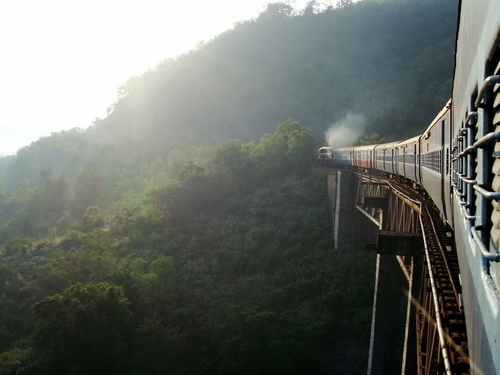
Most of the travel which I have undertaken has been by Trains. Whether it may be a trip to home-town by inter-state trains or for attending college classes by local trains or now regular commute to the office by the MMTS, the spacious Aluminium Alloy body swift local trains of Hyderabad, trains have always been my companion.

My fascination and bonding with the trains extend from the days when I was a kid and if you are going to board a train in the coming days, then you can be pretty sure it was the holiday season and the days were going to be filled with extreme fun, away from school, and with the parents, their parents and my cousins. Alas! those days are not going to return anyway!!

With trains a travel is a journey minus the jejune jerks, breaking blasts, horrendous horns, spewing smoke and Newtonian Inertial law principles playing with you. And of course there is Centrifugal and Centripetal Combo on the sharp turns and the overrides. One does not feel that he/she is on a F-16 on a roll, when on a train.

Trains are always rhythmic and jocular whether the journey is short or spanning days. She goes on carrying the rhythm within her and whistling along and in her embrace we move. She has the courtesy of treating all alike, Rich or Poor, the Ill or the Hearty, a Nubile or a Septuagenarian. She pays respect by coming to a still for all, who are in a need of her timely help.

People have nerves of steel, she runs on them. She is a shining example of ruthless speed combined with  the discipline of staying on course and bang on time. She is my Train! My gal!


Friday, February 18, 2011

I Love Routine

I love routine. It enables one to add things, small and big, to one's daily life.

I tend to write things up on a whiteboard or a planner for concrete implementation of a routine. Writing things up or listing pending and future work helps those who have in the past failed to complete tasks however insignificant they might have been due to forgetfulness. Tools, makes humans stand out from the animals. 

Priority matters. Without prioritizing the list of work, most of the times one can get normal results and a few times end up screwing up bad. Prioritizing not only increases efficiency but also makes you result oriented.
One fine morning I wanted to have Omelette for Breakfast and wash some of my dirty pantaloons. Then there was a 0904 train to catch to my workplace. So here the priority was to get to the train than to make a nice crispy Omelette. Working backwards keeping the highest priority task in mind made me accomplish that morning's task. Nobody will ever want you to complete all your tasks. Just the Top 5 :).
Everybody is interested in Top 10, 5 or 3. You know that, don't you?

Parallel processing does make sense not only in Computing world but also in our daily life since our brain is also a computing organ. Our brain can simultaneously work on parallel streams of thought as well as actions. One should take advantage of this gift of God to humans. I do.
I love cooking. There is none other task so satisfying than cooking, yes except extending a helping hand  to the needy (we will discuss on this topic in further Blogs). A skilled and efficient cook knows the criticality of timing and knows that the hungry has no patience. If you are one of the few who don't have the entire evening to make dishes and please others but love cooking will know that kitchen is the best lab for testing the validity of Parallel processing. I make my Omelettes on one of the burners and filter coffee on the other (That is why we have multiple burners ;)). Meanwhile you can wash dishes, while readying your favourite Coffee mug for the coffee and listening to Eminem rap. A perfect implementation of allocation of time slots.

The driving factor of maintaining a routine is that it helps you to remain efficient and valid in this society. But it is advisable to break the shackles of your routine. This is for 2 reasons:
a. When you break away from your routine, you can observe and adopt new elements. It promises to bring new dimensions to the daily life.
b. When you break away from the routine, and then come back, then you realize the importance of it. As they say, "Loved ones are missed when they are gone."

Best wishes!
Sunit Ronnie Ghosh


Saturday, February 12, 2011

Cricket Mania


World Cup is about to begin. Frenzy everywhere, anticipation infectious. People are delighted. They are collecting paper glossed time tables with elaborate details. Newspapers are printing the opinions of the cricketers of all times, the young and the old, the hot and the not.

Even if I am bound not to generalize, I have to say people are involved at different levels in cricket. I have the following categories:

a. These are the people who have the true knowledge of the game and know the tricks and the trade of it. They enjoy playing the game and therefore, follow the game like a fanatic, as they see their abilities being appreciated by many in another form. This breed owns auto-biologies of the greats. This breed argues and discusses various rules and regulations of the game. This breed is rare and is worthy of notice.

b. These are the people who have superficial knowledge of the game and their dedication and loyalty to the game supersedes the former. These are the folks who have once played cricket but now don't. The magic of the game still controls them. These are the ones who, even though don't have or don't intend to know more about the game, but have un-shattering faith on the game.

c. These are the people who are spell bound and mesmerized by the hoopla and the hype around the game. They might have played cricket in their childhood out of playfulness but they see cricket now as a gem owned by others but whose shine twinkles in their own eyes.

d. These are the people who use cricket as the topic to break the ice between colleagues and fellow peers when they meet and discuss the recent match highlights as a means to make their place in the group. They neither have the interest to plunge into the details nor intent to do so. These are the folks who are bound to the game only because they find no other way to make their place in the cricket-dominated discussions. They are the ones who know in the back of the mind that there are other more worthy things to discuss and ponder upon, but do not dare to reveal, and flow with the flow.

Which one is you? Do you dare to differ? Anyways enjoy the World Cup!


Sunday, February 6, 2011

My First Music Concert

Hi Readers,

It Feels good when you have something to blog about after a while. Though I did not purposefully wanted to stay away from my blogger account, but sometimes you are in such a fix that you forget your loved ones.

OK, yesterday, I did something which I can add to my list of "DONE" things in my life. Celebrities have been eluding me for the part of life till yesterday. Shreya Ghoshal, a super pretty, talented like hell Bong lass was the one who gave me my first time.

Friends, as they say, add to your life. So I would like to say thanks to my friends who gave me this opportunity and had the time and consideration to ask to accompany. Thanks Yaars.

As always, there were many things to learn on the way. In a city, you can neither master all the routes nor can you know all the places. Such one place was the venue where she had landed for the performance. Also, this gave us the chance to interview, although lasting a few seconds every-time, a score of Auto-Drivers of Secunderabad. So we made some new friends. Paid them too, sometime heavily for their friendly time with them.

What is the one thing you will find every where in India owing to the ever exploding population? People queuing up to kilometres of length. This time was also not an exception. Maintaining civility were a dozen of Burly Bouncers. I appreciated the built of one and he gave me a deadly look. I scampered ahead.

Though, we spent a good amount of time in the queue, we could hear the honey laded voice of Shreya. It made us to keep on moving ahead in the queue.

At the far end of the stadium she was singing with full energy and gusto, inviting us closer. Two huge screens were projected upon for the audience to get a closer look at her. VIPs had the luxury of seating in the front 20 rows. We managed to get closer but she was visible to us like a golden miniature doll glittering and reflecting all the spotlight focussed on her.

We enjoyed and she kept on mesmerizing and hypnotising us with her charm and scintillating songs, back to back.

But the time soon came where we had to return but taking a to-be-remembered experience with us.


God bless Shreya!

Thursday, January 20, 2011

Java Blog@Oracle , JavaSpotLight #13

Hi Java Enthusiasts,

Podcast #13 from Oracle's Java blog is out now, posted on Jan 19, 2011. In the 20:44 minute long podcast, the discussion focused on,


1. JDK 7 is feature complete: 

The JDK 7 project has reached Feature Complete (FC). This means that development and QA have finished all planned feature and test development work in the release and are moving the focus to testing and bug fixing on all supported JDK 7 platforms. This is a major step towards JDK 7 General Availability (GA) and implies that we are tracking close to the plan published on openjdk.java.net.

For more info, click here.


2. WebLogic 10.3.4 released:

Version 10.3.4 of Oracle WebLogic Server is now available along with the rest of the Fusion Middleware set of products. Here are some of the new features in this release :
• Exalogic Elastic Cloud Software Support
• Support for TopLink JPA 2.0 with patch 9923849
• Enhanced support for Oracle RAC with a Grid Link Data Source
• Certification with JAX-RS Jersey

For more info, please click here.


3. JPA 2.1 and JAX-RS 2.0 JSRs filed:

The formal work on Java EE 7 has started with the filing of two new JSRs :
JSR 338: Java Persistence 2.1
The Java Persistence API is the Java API for the management of persistence and object/relational mapping in Java EE and Java SE environments.

JSR 339: JAX-RS 2.0: The Java API for RESTful Web Services
This JSR will develop the next version of JAX-RS, the API for for RESTful (Representational State Transfer) Web Services in the Java Platform.

More info here.


4. Mac OSX Port:

The goal of this Project is to produce a high-quality, open source version of JDK 7 for the Mac. The final release has the following goals:

  • Pass all appropriate certification tests for Java SE 7
  • Include a complete, native Cocoa-based UI Toolkit
  • Provide excellent performance

More info here.


5. Feature Interview of Roberto Chinnici on Java EE Platform Lead on the futures in Java EE


Thanks and warm wishes!
Sunit Ronnie Ghosh

Monday, January 17, 2011

Ten Tips to Creating the Perfect Career

Hi Job Seekers,


Recently I was going through the Book "Answering Tough Interview Questions For Dummies". I found the last chapter about "Ten Tips to Creating the Perfect Career". After reading that, I felt to share the content of the same to you all. I have pruned the content to make it more readable and brief.


10. Knowing What You Want in a Job

Many people aren’t that happy in their jobs. But given that we often spend more time at work than we do at home, wouldn’t thinking about how we can be more fulfilled in our jobs make good sense? Only when you have an idea of where you want to go can you start to think about the steps necessary to get there.

9. Understanding Yourself

Many people hold themselves back at work because they delude themselves about their true strengths and weaknesses. To some extent, I’d say that pretty much everybody allows themselves a few delusions. And often the reason people can’t get a new job is because interviewers can see some weakness in them that they refuse to see in themselves.

You need to understand your weaknesses before you can work on them. And the best way of identifying these weaknesses is to gather feedback from people who know you. Simply ask these people three questions:

  • What are my strengths?
  • What are my weaknesses?
  • How can I improve on my weaknesses?

8. Working on Your Weaknesses

Don’t ignore the feedback you receive from people. Dismissing feedback and thinking that these people don’t understand the real you is easy. But remember that if the people who know you can see certain weaknesses in you, then employers may decide not to give you a job because they can see those weaknesses too.


7. Networking Widely

A massive market of jobs is never advertised, but instead filled by word-of-mouth alone. And the only way to access those jobs is to make sure that people know about you, your skills, and experience. If you only take on board one piece of advice for building a successful and rewarding career network more widely.


6. Asking to See Offers in Writing

Being offered a job is a great feeling. Hurrah and congratulations! But always ask to see an offer in writing. You can read through the document at your own pace and see exactly what the company is offering you. Apart from the salary itself, does the offer satisfy your needs in terms of benefits? Employers can and do occasionally retract offers due to unforeseen circumstances. So keep attending interviews and never close off other job options until you’ve signed an iron-clad employment contract.


5. Evaluating the Job Thoroughly

Apart from the pay and benefits, other factors are also important in considering a job offer. How much do you really want this job? How does it fit in with your long-term career plans? Given that you may be spending many months or even years in the job, do you think you’ll enjoy it? No employer is ever perfect for you. Always ask for at least a couple of days – more if the role is senior – to think about a job offer and consider whether the position is totally right for you.


4. Considering Culture Carefully

Being chosen over other candidates and offered a new job is thrilling. But remember that employers rarely tell candidates exactly what working for their company is like – or at least not voluntarily. Interviewers and recruitment brochures are there to sell a job to prospective candidates.

In deciding whether to accept a new job offer, you should weigh up the culture of the organisation – the unspoken rules that govern how people really behave at work.


3. Negotiating a Good Deal for Yourself

Your best chance to negotiate a better deal for yourself is when the interviewers offer you the job. They have eliminated   the other candidates and decided that you are the only person that they want. If you’re unsatisfied with the salary or benefits, or perhaps the conditions of the job, you have nothing to lose by asking to have them tweaked to your satisfaction. Don’t think only about asking for more pay or benefits. You may also want to consider options such as, the hours that you work, the nature of your job, the opportunities for training and your financial needs.


2. Investing in Your Future

Most people are full of enthusiasm on joining a new organisation. But that enthusiasm can fade after a few years or even months. And then those people end up putting themselves on autopilot – going through the motions but not thinking about what they can do to push themselves and develop in their careers.

Cruising is fine until you look for a new job. Interviewers want to know about your achievements. Will you have anything worthwhile to talk about?

Make sure that you build up your CV by participating in big projects, volunteering to join committees, chasing promotions, or at least moving departments every couple of years. Always think about storing up achievements to put onto your CV and talk about in future interviews.

Your employer may say that they have your best interests at heart – but in reality the needs of the organisation always come above yours. If you don’t look after your own career, no one else will!


1. Looking for Opportunities to Grow

Employers don’t like to give big pay rises to long-standing employees. And getting more responsibility can be difficult if an organisation is happy to leave you where you are. Often, the only way to get more money or responsibility is to change employers. So always keep an eye on the jobs sections of newspapers and relevant Web sites.

Keep in touch with headhunters and recruitment consultants. Even if you’re not currently thinking about changing jobs, update your CV and send it to them at least once a year so that you’re on file for possible future opportunities.


Well Wisher,
Sunit Ronnie Ghosh
Please note, as the author has already mentioned the reference of the material above and has no rights what so ever on the content. Please buy the book to read the contents.

Sunday, January 16, 2011

Flickr.com Alert

Hi,


If you have a Yahoo Mail account, then effective 2007 all the attachment photographs in your e-mail account were migrated to Flickr.com.

Most worrying fact is that, even though your attachment photos of the e-mail account are private, they are open to any Flickr.com member at your Flickr.com account as default after migration.

It is recommended to visit Flickr.com and login through your Yahoo credentials and either change the settings or if you are not using it, delete the Flickr.com account. You can create it again when required.


Well Wisher,
Sunit Ronnie Ghosh

Saturday, January 15, 2011

IIM Kozhikode Attractive Admission rules

Hi MBA Aspirants,


IIM K is having a three stage selection process this year: 

Stage 1: All students with the below CAT percentile and above will have to register online here and will be considered for the second stage. Last date for registration is 21st Jan, 2011.

QADIVerbalOverall
General55555575
NC-OBC50505065
SC45454555
ST40404045
PWD - Low Vision40404045
PWD - Hearing Impairment40404045
PWD - Locomotor Disability / Cerebral Palsy 40404045


Stage 2: From this pool of registered candidates, IIM K will release the GD/PI list on the basis of the below weight-distribution:
  • CAT score - 50 %
  • 10th Standard - 20 %
  • 12th Standard - 20 %
  • Graduation - 10 % 

Stage 3: For stage three, the below weight-distribution will be used to release the final shortlist for admission:
  • Stage 2 score - 30% (The stage 2 score will be indexed to 30%)
  • Essay (Extempore essay on a topic: 30 mins) - 20%
  • Personal Interview - 35%
  • Profile - 15%


Please note that the above information is available here and the author does not owns or takes responsibility over the changes in the information for the same.


Best Wishes,
Sunit Ronnie Ghosh.

Java Blog@Oracle , JavaSpotLight #12

Hi Java Enthusiasts,

Podcast #12 from Oracle's Java blog is out now, posted on Jan 13, 2011. In the 30:16 minute long podcast, the discussion focused on,


1. GlassFish webinar series : 

With GlassFish 3.1 soon to be released, and Java EE 6 still a very popular topic, the GlassFish Webinar Series has you covered on lots of different topics. That's no less than 12 webinars scheduled before the end of May to cover the Java EE programming model, various tools, what's new in GlassFish 3.1, clustering, admin, productivity, Coherence*Web integration, HK2, Security, Embedded and more.

Free registration for the webinar link is also available.

For more info, click here.


2. Roller 5 on multiple Java EE AppServers:

Apache Roller is a full-featured, multi-user and group-blog server suitable for blog sites, large and small. Roller is a Java web application that runs on any Java EE server and any relational database and will soon ship version 5. Some of Roller's key features are, Multi-user blogging, Group blogging with three permisson levels (editor, author and limited), Support for comment moderation, control over blog layout/style via templates, Built-in search engine, Pluggable cache and rendering system, Support for blog clients that support MetaWeblog API and all blogs have entry and comment feeds in both RSS 2.0 and Atom 1.0 formats

It powers internal and external employee blogs at Sun, IBM and other companies as well as the JRoller.com Java blogging community. It also powers the Oracle Java blog (and all of blogs.sun.com - 5k+ blogs, 145k entries, hundreds of thousands of hits every day).

For more info, please click here and here.


3. Update on GlassFish 3.1:

GlassFish 3.1 Open Source Edition is scheduled to ship in February 2011. Building on the modular, Java EE 6 based GlassFish Server Open Source Edition 3.0, version 3.1 is the next major release of GlassFish Server Open Source Edition. This release is currently under development and will focus on the following features:

  • Clustering and Centralized Administration
  • High Availability

More info here.


4. Interview with Adam Bien:

Adam Bien has started Java development with JDK 1.0 in 1996. And since then, he has spent his whole career as a freelancer working on the server side with Java with efforts towards client side too. Following things were discussed during the interview.

  • Swing and JavaFX 2.0 with java API with emphasis on Java FX script.
  • With Java FX 2.0, with the Java API we can work with Groovy, Scala and the four guys, JRuby.
  • Ease of Java EE 6 and 7 development.
  • Apple's donation of Mac OS X to OpenJDK.


5. Oracle Magazine January/Februray 2011 - Simplicity by Design


6. 10 Things Java Should Steal from Ruby:

This was a session that was done by Bruce Tate in August of 2006. Discussion on how things look today is given below:

  • Continuations which are basically syntactic method of implementing certain types of optimization, are not deemed to be a part of Java.
  • Meta-programming is not available to Java because of the very nature of how statically typed the language is.
  • Conventions over XML, ease of development in Java EE 5, which had to do with convention of a configuration as well as annotations rather than XML if you wanted to change that default behavior.

There were few other points which can be heard in the podcast.


Thanks and warm wishes!
Sunit Ronnie Ghosh

Tuesday, January 11, 2011

Java Blog@Oracle, JavaSpotLight #11

Hi Java Enthusiasts,

Podcast #11 from Oracle's Java blog is out now, posted on Jan 06, 2011. In the 18:31 minute long podcast, the discussion focused on,

1. JavaTest team release JTHarness 4.3 at java.net : 

The JT harness is based on Oracle's JavaTest harness. The JT harness is a general purpose, fully-featured, flexible, and configurable test harness very well suited for most types of unit testing. Originally developed as a test harness to run TCK test suites, it has since evolved into a general purpose test platform. The JT harness:
  • Is designed to configure, sequence, and run test suites that consist of many (100,000 or more) discrete, independent tests. It is especially good at testing APIs and compilers.
  • Can be used to run tests on all of the Java platforms, from the Java Card platform, to the Java Platform, Enterprise Edition ("Java EE").
  • Enables you to create test suites that are self-contained products that customers can easily configure and run.
Source and more info here.


2. JBoss 6.0 Community Release:

RedHat has now released JBoss 6.0, a Java EE 6 Web Profile product. It is a community release, meaning that support on this product is not available, yet! This release adds another player to the growing list of JavaEE implementations which means more choice for developers. With JBoss AS officially implementing the Java EE 6 spec now, a new baseline for Java EE has been set. From now on, technologies like JSF 2.0, EJB3.1, JPA 2.0 and CDI can really be considered as basic, standard available techs.

More here.


3. New version of LeonardoSketch released, including Amino toolkit:

Leonardo is an open source vector drawing program named after the 15th century painter, but aimed for the 21st century user.  It focuses on common tasks like mock ups, prototyping, quick vector sketches, and presentations with a clean and consistent user interface. Leo is designed to be augmented by Internet webservices and plugins created in several scripting languages.
Current Features include:
  • export to PNG, HTML, HTML Canvas, SVG, Email, and Twitter.
  • import from SVG (partial support)
  • vector drawing with curves, shapes, and text.
  • common reusable symbols stored in a sidebar
  • integrated Creative Commons Flickr search

More info here.


4. Events@Oracle:


5. Feature interview with Nabor Coutinho De Oliveira Junior

Nabor Coutinho De Oliveira Junior is the Manager of Mobile Internet and Messaging for Tim Cellular. The interview was focused on inviting developers from Brazil and across the world to develop for the TIM Cellular Application Store.

TIM website here.


6. The future of JSR-310, Date and Time API:

More here.

Monday, January 10, 2011

The Curious Case Of GWT And AppEngine

On 16th July 2007, I met with an interesting Guy. Our friendship is now 42 months old. Though, his name as a word drips with arrogance when used as a verb, he is a cheerful chap and is very comfortable around all kinds of Plug-ins. Plug-ins, yes this is what he calls compatible friendship between him and an another person. Meet my friend Eclipse. His full name is "Eclipse 3.5 Galileo". And yes his middle name is a float. No wonder he is as awesome as he seems to be.

Yesterday I spent the whole day with him, chatting, poking and making merry. Remembering good ol' days of our friendship. Enough. Reality now.

Yesterday I was interfering into Google matters. Pursuing it seriously. Very serious. Mission objective was to make my friend Eclipse gain some weight. I wanted to feed him some high protein food. On the Google website the name of the thing was given as "Google Web Toolkit 2.1.1 SDK + Plugin" and "Google App Engine 1.4.0 SDK". What a weird name for a food for my friend.

I was told "Google Web Toolkit 2.1.1 SDK + Plugin" will help him to help me instead to know and learn something to do with Ajax. And the other one "Google App Engine 1.4.0 SDK" will help me to know and learn Cloud Computing Application Development. What? I said, Clouds, now is this something to learn. Ajax and Cloud?? Where am I, a Flying club or Disney Land. O.K. Let us see.

I fed him through his mouth which, the manual said, is called "Install New Software..." and is present in the Help Tab. I fed him the link. He seemed to gobble it down first , but then lost his appetite. I wondered what happened to my dear friend.


I contacted my Internet Doctor, a doctor for all remedies, Doctor Google. He prescribed a help forum for Guys named Eclipse. They told me to brush his mouth and clear it of all the "Available Software Sites" from "Windows>>Preference>>Install/Update>>Available Software Sites" and then feed him the link. I did just that and found that my friend "Eclipse 3.5 Galileo" went all normal gobbling up all the bandwidth and ate all of the 100MB SDK and plugin.

He is all fat and chubby now, helping me in learning Java Ajax Framework called Google Web Toolkit and Cloud computing App Engine. So nice of him. Thanks for being my friend "Eclipse 3.5 Galileo".

Sunday, January 9, 2011

Ajax

Hello there, Java Enthusiasts,

I wanted to share some notes on Ajax and related stuff. Hope it helps to summarize briefly. This blog article will be updated with more information from time to time.

Ajax shorthand for Asynchronous JavaScript and XML is a combination of the technologies:
  1. HTML or XHTML and CSS for presentation
  2. the Document Object Model (DOM) for dynamic display of and interaction with data
  3. XML for the interchange of data, and XSLT for its manipulation
  4. the XMLHttpRequest object for asynchronous communication
  5. JavaScript to bring these technologies together

With Ajax, web applications can retrieve data from the server asynchronously in the background without interfering with the display and behaviour of the existing page. Data is usually retrieved using the XMLHttpRequest object.

The term Ajax was coined on February 18, 2005 by Jesse James Garrett in an article entitled Ajax: A New Approach to Web Applications.

On April 5, 2006 the World Wide Web Consortium (W3C) released the first draft specification for the XMLHttpRequest object in an attempt to create an official web standard.

The utility of background HTTP requests to the server and asynchronous web technologies remained fairly obscure until it started appearing in full scale online applications such as Outlook Web Access (2000) and Oddpost (2002), and later, Google made a wide deployment of Ajax with Gmail (2004) and Google Maps (2005).

With traditional Ajax Client polling is used. Reverse Ajax describes the implementation of either Client polling or Server pushing models, or a combination of both. The design pattern is also known as Ajax Push, Full Duplex Ajax and Streaming Ajax.

An Ajax framework is a web application framework that helps to develop web applications that use Ajax. The goal of the framework is to provide the Ajax engine and associated server and client-side functions. Types of frameworks, according to the features they offer and the skills required of the user, include,
  1. Direct Ajax frameworks (require HTML, CSS and Ajax expertise), 
  2. Indirect Ajax frameworks (based on compiler technology, a high-level language is used), 
  3. Ajax component frameworks (offer pre-built components) and 
  4. Server-driven Ajax frameworks (offer a server-side component-based development model with some degree of Ajax support).
List of Ajax frameworks
JavaScript frameworks are browser-side frameworks very commonly used in Ajax development such as jQuery, SWFObject, jQuery UI, Prototype, Yahoo! UI Library, script.aculo.us etc.

Java frameworks use Java for server-side Ajax operations such as Apache Wicket, AribaWeb, Google Web Toolkit, Richfaces etc.

Others are Pyjamas for Python, Wt - a C++ Web Toolkit, ASP.NET AJAX from .NET, Sajax and Xajax for PHP and RJS for Ruby on Rails.